Here is
a very brief description of how I do batik on cotton.
There are many other
“systems,” but all include the use of wax to resist dye.
Planning:
First a design is drawn with pencil or charcoal on
the back of white cotton. Then the cotton is stretched on wooden stretcher
bars in preparation for waxing.
Waxing:
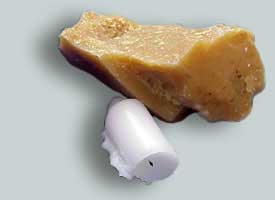
Next, a molten mixture of beeswax and paraffin is painted,
spattered, stamped, or otherwise applied to any areas where the silk is
to remain white. The first waxing is done from the back, following the
drawing. The next waxing is done from the front, to give a full resist.
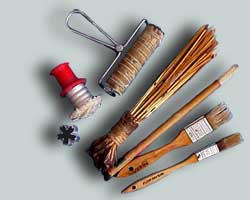
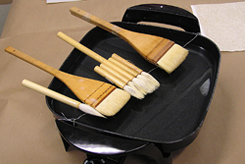
These are a few useful wax tools: roller, brushes,
dauber, metal stamp, spatter
brush. All bristles
must be natural fibers, since synthetic materials
would
melt in the hot wax.
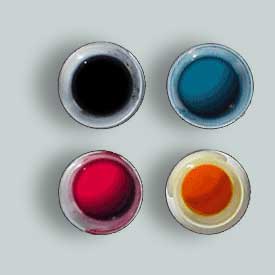
Procion MX Fiber-reactive dyes: These
come in powdered form and are mixed with water and urea. I mix all colors
from warm red, cool red, yellow, turquoise blue, navy, and black.
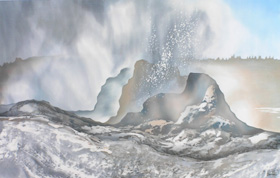
GROTTO gEYSER, YELLOWSTONE
Batik on cotton
40 x 28"
contact the artist
Dyeing:
The stretched cotton is dampened with a soda ash solution
and the lightest color of dye is brushed on with Chinese hake brushes.
The first dye may be applied as a wash, similar to watercolor. The dyed
cloth must be kept damp overnight at a temperature between 75 and 90 degrees
Farenheit so that the fiber-reactive dyes become permanent. This process
is called batching.
In the morning, the cotton is rinsed in cool water
to remove any soda ash, dried, and restretched.
Repeat the above 2 steps up to 20 times...
Then, wax is applied to areas which are to remain this
color, and the next darker dye is applied. Each color is affected by the
color it goes over: turquoise over yellow makes green, etc. Each layer
of dyeing and waxing takes one day. Many of my cotton pieces require up
to 20 layers, so the process may take several weeks for only one piece.
The last dyeing is usually the darkest color. Anywhere
the wax has cracked, the dye penetrates, forming dark lines called crackle.
Sometimes I use it, sometimes not.
Finishing the
batik painting:
Finally, the cotton is dipped in boiling water to remove
the wax, and the piece is then washed, ironed, and sewn to acid-free foam
core mounting board. An acid-free double mat covers the stitches, and
the piece is framed under ultraviolet-screening glass.
Fine art should never be hung in direct sunlight.
See detailed information on the batik process by Paula
Burch.