Dorothy Bunny Bowen Rozome, Batik and Silk Painting Classes

These are a few of the amazing artists with whom I have been privileged to study:

Yusuke and Kiyoe Tange, SDA 2007

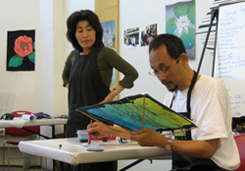
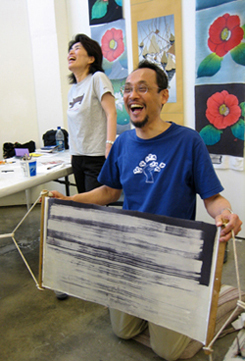
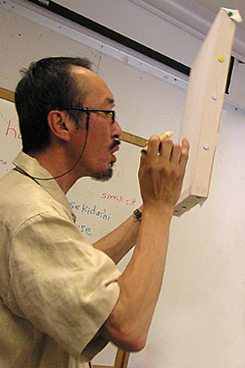
Yusuke and Kiyoe Tange show his demonstration piece done with a shikebiki wax brush.

Tange-san and Betsy Sterling Benjamin, instructors.

Tange-san and Betsy Sterling Benjamin, instructors.

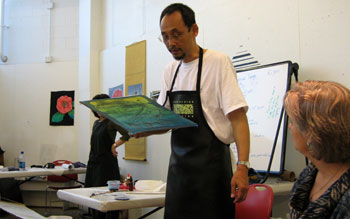
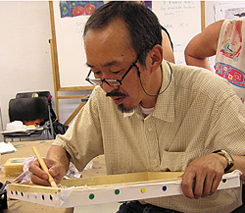
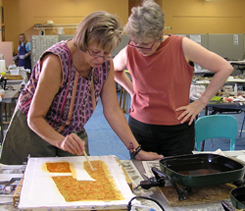
Tange-san demonstrates dyeing lines etched in wax (scrafitto).

Tange-san demonstrates how to dye lines etched in wax (scrafitto).

THE CONTEMPLATIVE STROKE

Master Class taught by Yusuke Tange and his former student, Betsy Sterling Benjamin.
Post-conference workshop, Surface Design Conference, Kansas City, June 2007.

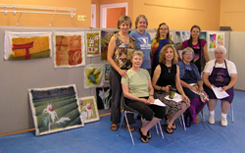
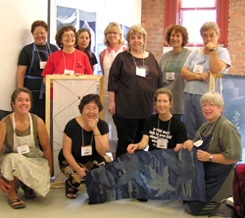
Tange-san is recognized in his native Japan as a true Rozome Master. His former student, Betsy Sterling Benjamin, has herself become known as a Rozome Master, introducing this amazing medium to many students all over the world. In June, 2007, ten students gathered for a once-in-a-lifetime opportunity to study with these two generous teachers. Kiyoe Tange, a master dyer in her own right, graciously assisted in the class.

top of page

Kobayashi-san demonstrating han-bosen

Kobayashi-san applying hot wax in the han-bosen technique.

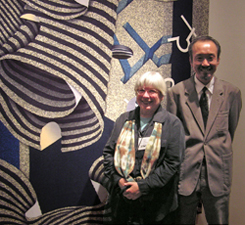
Bunny Bowen and Shoukoh Kobayashi, World Batik Conference 2005

Bunny and Kobayashi-san in front of his work Wind'04 at the opening reception,
Rozome Masters Exhibit,
Massachusetts Sshool of Art, June 2005.

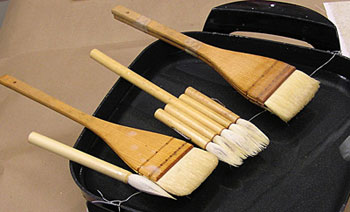
Rozome brushes stay warm suspended over the hot wax.

Exquisite example of han-bosen (half resist) by Shoukoh Kobayashi.
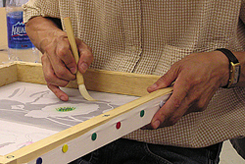
Above and left: Kobayashi-san demonstrating sekidashi (barrier resist).

ADVANCED JAPANESE ROZOME

Master Class taught by internationally known artist Shoukoh Kobayashi, World Batik Conference, Boston, June 2005.

This workshop covered many basic techniques of Japanese batik or rozome, including wax line and sekidashi (barrier resist) as well as specialized techniques such as maki-ro (sprinkled wax) and han-bosen (shaded wax application), techniques for which Kobayashi-san is famous. We all left inspired by his patience, his extraordinary rozome skill, and his good humor.

top of page

WBC master class

students doing homework

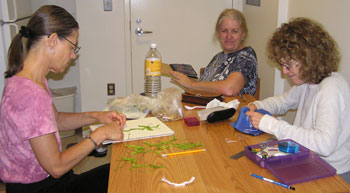
Above: Students sharing homework.
Left: Master class, WBC 2005.

student work

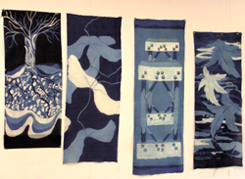
Student work: indigo dye with wax resist on hemp.

Keijin Ihaya

Ihaya-san with ro (wax) brushes.

NATURE-INSPIRED ROZOME

Master Class taught by Keijin Ihaya, Kyoto, Japan, World Batik Conference, Boston, June 2005.

This workshop provided an opportunity to see how nature studies influence a master’s work and mode of expression in rozome. The class combined drawings from nature with rozome techniques to develop personal creativity and expression. We practiced sekidashi (barrier resist) and sengaki (line drawing with wax). All work was dyed in an indigo vat. Ihaya-san's sharp eye for design, technical expertise, and supportive empathy for his students made this a memorable class. Again, a once-in-a-lifetime opportunity!

top of page

Rozome on the Rio, 2006

Rozome on the Rio, 2006
Bernalillo, NM.

Betsy sharing her sekidashi skills.

Betsy sharing her sekidashi skills.

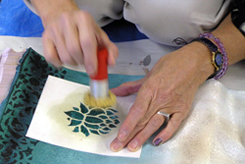
Betsy demonstrating the use of a wax stencil.

Betsy demonstrating the use of a wax stencil.

Betsy Sterling Benjamin

ROZOME ON THE RIO: Masters Classes 2002-2006

Betsy Sterling Benjamin introduced me to rozome in 1999, and I have since taken (and sponsored) a number of masters level classes with her. Author of the only book in English on rozome, she spent 18 years in Kyoto learning and absorbing this highly challenging technique. She has mentored many artists around the world and continues to create and exhibit her work, to lecture and to inspire us all to reach “just that much further” than we thought we could.
To learn more about Betsy, visit her website, www.BetsySterlingBenjamin.com

top of page

db